

how to clean mold off of books
 Mold Contamination on Books, Paper, Photos
Remove mold stains & foxing on books & papers
- POST a QUESTION or COMMENT about mold contamination on books, papers, libraries, documents
InspectAPedia tolerates no conflicts of interest. We have no relationship with advertisers, products, or services discussed at this website.
Mold contamination on or in books, magazines, photographs or other paper products:
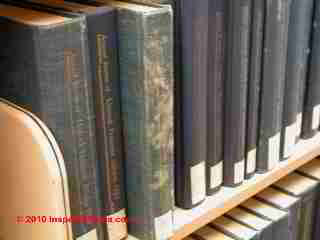
This article explains how to deal with mold on books and papers, and what options we have for cleaning or storing moldy books. The moldy books in a college library (photo above) were in the opinion of some people "an old inactive mold problem" but see our warning below about "dormant mold".
The extensive range and area of moldy books in this library was capable of producing very high (and unsafe) levels of harmful mold spores.
We also provide an ARTICLE INDEX for this topic, or you can try the page top or bottom SEARCH BOX as a quick way to find information you need.
Moldy Books and Papers - Can I Save Moldy Books?
 Question: Is it possible to get rid of mold in books?
I have mold disease and I'm wondering if it's at all possible to get rid of mold in books or if I need to give them all away. Should I even try? - E.A.
[Click to enlarge any image]
Article Contents
- BOOK MOLD, CLEANING
- PREPARE TO CLEAN BOOKS / PAPERS
- HEALTH HAZARDS, MOLDY BOOKS
- DUST, TYPICAL LIBRARY SHELF CONTENTS
- BOOK-MOLD CLEANUP for DO-IT-YOURSELFers
- MAGAZINE MOLD CLEANUP for DO-IT-YOURSELFers
- MILDEW on BOOKS? - no, it's NOT mildew.
- BOOK CONSERVATION RESOURCES
Answer:
OPINION: A competent onsite inspection by an expert usually finds additional clues that help accurately diagnose a problem, so it could be dangerous to assume that the moldy books are the only or even the most serious mold problem in your home.
Watch out: as you indicate that you personally have a mold-related illness, you should not attempt a mold cleanup project yourself without first checking with your doctor. Most likely the physician will tell you to keep your hands off of mold stuff, and to have a professional handle the cleanup (negative air, dust control, containment, etc).
See DO-IT-YOURSELF MOLD CLEANUP WARNINGS.
Also see MOLD RELATED ILLNESS SYMPTOMS.
As we explain at MOLD AGE, HOW OLD is the MOLD?, especially in older buildings where there has been a recent sudden leak event associated with mold growth, it is often possible to identify pre-existing mold as well as mold-producing conditions.
Considerations When Preparing to Clean or Salvage Moldy Books or Papers
That said, here are some things to consider when deciding to clean or scrap moldy books or papers:
- First inspect the books carefully (or have someone not mold sensitive do that inspection - see our warnings below).
IF mold is only on the book exterior, you can probably wipe down the book exterior or brush the book exterior.
You could use any household cleaner, even water. We're not trying to kill the mold, we're trying to remove it. If you can remove loose mold from the book exterior it wont' hurt if some stains remain.
- As a DIY book mold removal project, some folks have successfully cleaned books that suffered just exterior mold, but it may leave a moldy smell in some or all of the books even when there is no longer visible mold.
- How we should clean the book exterior: take your books outside for cleaning on a dry sunny day.
But work in the shade. Excessive sun exposure can damage books by fading and warping. (OK so if it's just one book I clean it in the kitchen.) The book exterior is lightly brushed, or much better, HEPA (High Efficiency Particulate Air - a filter system that traps very small particles) vacuumed, gently so as not to damage the book.
Watch out: if you try using an ordinary household vacuum that is leaky and especially not HEPA rated, you will be aerating small mold spores, creating a potential health hazard and sending potentially harmful dust throughout the building.
If you do not have access to a HEPA-rated vacuum cleaner, you may have some book cleaning success using a "magnetic" wiping cloth such as Swifter Sweeper Dry Sweeping Cloths [REFERENCES] , un-scented but be careful to avoid using wipes that are themselves dampened with a chemical, cleaner, or perfume - see our next warning below.
At REFERENCES we list book water disaster procedures, book conservation articles, and cleaning and HEPA vacuum supply sources.
For certain sticky deposits found on some book exteriors (candy, sugar) we used a very slightly-damp steri-wipe or disposable cloth to wipe the book exterior.
Use alcohol to clean off mold? Some book mold cleaning articles recommend using a wipe dampened with ethyl alcohol - enough to clean but not so much as to make ink run. An advantage alcohol has over water is its rapid and easy evaporation - there is no risk that the alcohol-wet paper is going to invite mold growth. Alcohol wipes work best on glossy hard-surfaced clay-coated papers such as some magazines and on paperback books.
Watch out: we do not recommend the advice we've read by some who advise using a damp sponge to wipe the book.
Using our portable field lab we monitored a major book cleaning operation conducted for a U.S. National Park Service facility in New York. According to book conservation experts such as the Department of Preservation & Collection Maintenance, Cornell University Library:
- Do not wipe your books with any cloth treated with wax, liquid, or perfumes; chemical additives may harm your books.
- Test results for "cleaned" book surfaces: We inspected and tested (by collecting surface samples of dust and debris) the level of mold on individual books before treatment and after each stage in the cleaning procedure - an initial wipe-down and an final outdoor wipe down and HEPA vacuum.
We found that mold was distributed at high levels uniformly over books leaving the cleaning station.
On investigation we found that the workers at the cleaning station were dipping a sponge (or rag) into a bucket of "disinfectant", then wiping each book, then rinsing the sponge/rag in the bucket again, then wiping the next book.
The result was that mold and fungal hyphae were quickly spread rather uniformly over every book that was processed - in some cases the level of book mold contamination was actually increased!
The solution was to use a disposable wipe or clean rag, wipe the book, and throw the wipe away or fold the clean
- Vacuuming moldy books: is a procedure we like, and we've also see references to using an "electrostatic duster" to clean the surface of books, but
Watch out: similar to our warning above about wiping books with a contaminated sponge or rag, we have sometimes found that a vacuum brush itself can become mold-contaminated and may spread mold from one surface to another.
However it may be possible to lightly vacuum book exteriors and the edges of moldy pages with the book closed, sufficient to significantly reduce the level of loose mold before then continuing with a wiping procedure.
- If the book interior pages are moldy, simple exterior book wiping won't do the trick. There are services that can clean moldy books but it's expensive, especially if mold is on more than the book exterior.
Treatment of individual pages of a valuable book absolutely needs to be performed by a conservator or other expert.
Just going at the book with bleach and rags can damage the book and even spread moldy debris throughout otherwise previously clean pages, just as we warned above about cross-contaminating one book exterior from another.
- Freezer treatment, Heat Treatment, or Microwave treatment for books: Some of our clients and readers have tried do-it-yourself mold cleanup methods like putting their moldy books in a freezer for a week or two to see if they can dryout and "kill" the mold.
Experts may use a "freeze-dry" system combined with cleaning.
Watch out: We are doubtful that a simple "overnight" treatment of a book in a freezer will be sufficient. Microwaving (heat) might also kill mold but it may also damage the book. And again, it's a mistake to try to "kill" mold when what's needed is to remove it. Even "dead" mold spores may be toxic or allergenic.See MOLD KILLING GUIDE.
- Heat treatment to attempt to deactivate mold, insects, bedbugs, etc. is often used for books, papers, even furniture or carpets. Exposure to temperatures at or above 180F for as little as an hour has been reported [citation needed] to be effective.
- Microwave treatment for books or furnishings is similar to more conventional heat treatment but may not be viable for products that contain metal, including metallic glazes, gold leaf, etc.
- Freezer treatment for moldy books & papers offers a potentially significant advantage in that it avoids the deterioration that may occur to books, papers, artwork or other items when subjected to high temperatures. However the procedures we have reviewed also require more time for freezer treatment (often at temperatures around -18F) than for heat treatment approaches.
- Foxing stains on books, papers & photos: reddish brown stains observed on book pages, paper edges, and on other paper documents & photographs are caused by a combination of humidity, mold colonization by certain genera/species, and paper chemistry including the presence of iron oxide.
Details about foxing are
at FOXING STAINS on BOOKS & PAPERS.
Deatails about conserving moldy photos are
at MOLD on PHOTOGRAPHS, CLEAN-UP
- After treatment by freezing, drying, or fumigating (?), books are then individually steri-wiped, HEPA vacuumed, and inspected. This treatment includes not just the book exterior, but its interior pages - that's why hiring a professional to clean and restore books is costly.
See MOLD CLEANERS - WHAT TO USE.
- Sun Treatment for Moldy-smelling books: That remaining musty or moldy smell or book odor, even after cleaning, will be a mold volatile organic compound or MVOC is itself a health or irritant problem to some people, especially someone who has become sensitized to mold, is asthmatic, or has other illnesses or fragile health. We have found that you can often significantly reduce MVOC levels and mold odors in cleaned books by placing them in sunlight but
Watch out: book conservators warn against leaving books in the sun. The sun will also warp and damage book covers, especially wet or damp books, and heaven forbid if it rains while you've left your books outside.See MVOCs & MOLDY MUSTY ODORS. And remember, the object is to remove the mold, not "kill" it.
- Valuable books: may be re-bound. If the book or books is or are valuable, and if the book binding is in poor condition as well as moldy, it may make sense to have the moldy binding removed, the book interior cleaned, and the book then re-bound. But this is certainly too costly for an ordinary home library.
- Storing books after mold removal: Some of our clients decided to keep valuable moldy books after drying them, vacuuming, wiping the books themselves.
But because the books smelled, they were permanently stored in air-tight plastic bins. The bins were opened and the individual book aired out when needed. Another client constructed a dry, air-tight bookcase with sealed doors for storage of their cleaned de-molded books. Be sure that the book container itself is dry and clean.
- After examination and brief use, the book was returned to the airtight storage bin.
- Other steps to prevent books from becoming moldy, besides storing them in a dry airtight container will start with a focus on storing books where they are not exposed to water or high humidity.
Watch out: for desiccants: We have read suggestions to use silica gel or other moisture-absorbing materials to try to keep stored books dry - it sounds like a great idea but we've seen some poor results when folks bought the silica gel, placed it and forgot it. Because the material is hygroscopic, it can ultimately become a soup that stops absorbing moisture and instead starts giving it back to the books.
We prefer to maintain humidity, where necessary, by removing unwanted moisture sources (leaks, poor venting) and using a dehumidifier.
See HUMIDITY CONTROL & TARGETS INDOORS.
So ultimately, if the books are valuable, some of them may merit professional cleaning. Otherwise, unless the mold on your books is superficial, it's more likely less costly to dispose of the moldy books and purchase new clean dry copies.
Dormant book or paper mold problems?
We have also read book mold cleaning articles recommending that you make the mold go "dormant" so that it's dry and powdery.
That makes some sense insofar as it's easier to vacuum or wipe off a dry powdery substance than damp moldy surfaces.
And while we wouldn't call it a "dormant" state, the ongoing growth of mold may slow or even stop if conditions are no longer favorable for the particular species present - for example, if the books are dried and kept at sufficiently low humidity. But be sure to see our health hazard warning immediately below.
Health Hazards of Moldy Book Collections: Clouds of Mold Rose from the Library Book Shelves
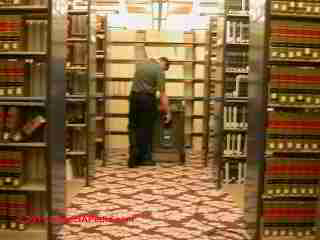
Watch out: The moldy books in a library (photo at page top and at left) were in the opinion of some of the parties "an old inactive mold problem".
But when workers began dehumidifying the area in preparation for a mold cleanup, conditions actually got quite dangerous:
there were so many moldy books with such thick mold growth that visible clouds of Aspergillus sp. spores were released into the air by small air currents caused by simply walking down the aisle between stacks of books.
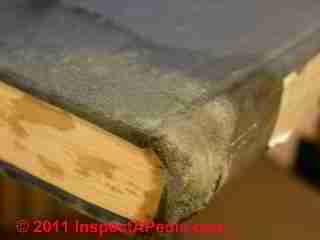
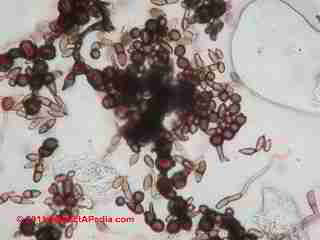
On book bindings we found heavy growths of Aspergillus sp. and on some books, Cladosporium sp. Not surprisingly, mold growth density varied significantly from book to book, even among adjacent books, depending on the binding materials.
Lab Photos of Book Mold from a Library
Our book mold lab photographs made from samples at the project above show dense Aspergillus sp. spores from a book binding surface (second photo below) and Cladosporium sp. fungal spores (below right) from a different book binding.
Very high levels of airborne Aspergillus sp. were found in the book storage area after the dehumidifiers began operating and before the cleanup had begun.
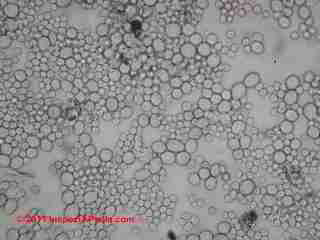
Below: Cladosporium spores and hyphal fragments:
Properties of Typical Library Bookshelf Dust
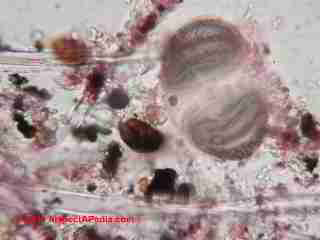
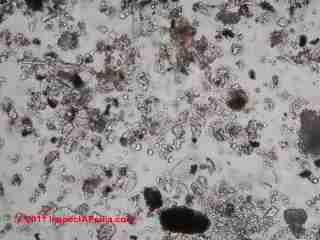
By contrast, our lab samples and photos of typical dust found on bookshelves in areas of a library that were not mold-contaminated were more like typical house dust.
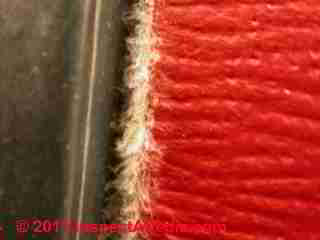
The dominant library dust particles were paper fibers, carpet fibers, skin cells and of course a few pollen grains and isolated fungal spores.
In our photo of typical library bookshelf dust (below left) that large particle is pine pollen. In older sections of a library and in basements, insect fragments and elevated levels of dust mite fecals.
Is there Ever Mildew on Books?
No.
Continuing from the comments on mold and mildew, where renovations had gone on nearby in the building, we found non-fungal granular debris typical of plaster or drywall dust (photo below right).
We have seen several articles that refer to mildew on books. Those writers are almost certainly technically mistaken. Mildew (a much smaller subclass of members of the mold family) is an obligate parasite that grows on living plants - like grapes.
So unless your books are bound in grape leaves, the fungal growth found on books and papers is indeed mold, often Aspergillus sp. (especially on bindings) or other problem molds, but it's not actually mildew (Oidium-Erysiphe - powdery mildew, or Peronosporaceae - downy mildew).
Causes of Foxing or Rust Stains in Books or on Paper
Question/Comment: what causes rusty stains or foxing marks on books and paper ? Foxing definition, chemistry, causes, treatments or removal methods, and prevention
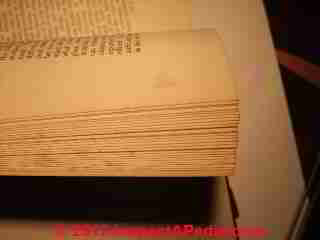
Are foxing marks on books and paper always caused by mould or are other factors also at work? Also, I have a couple of books with shiny pages that have become sticky during a humid summer and have developed orange lines along the edges of some of the pages.
Is this a reaction of the acid in the books seeping through the cut edges or could mould be a factor? - Rachel 9/2/202
Reply: iron oxide, fungi and yeast associated with foxing on books and papers: causes, cures, prevention
Rachel,
Your surmise that more than mold is at work in the development of local discoloration or reddish-brown foxing marks on paper and books is correct in that at the core, foxing is caused by exposure of those materials to high humidity, and the brown stains characteristic of foxing marks are typically found to contain high levels of iron oxide (FeO) in one or more chemical forms.
Paper chemistry as well as chemistry of inks and other materials comprising the book, paper, stamp, or other foxed document are also important components in the foxing problem. (Carter explains that the general yellowing of some paper products is distinct from the localized red-brown stains associated with foxing. [36][37])
Please see our detailed article that includes a more complete answer to your question, found
at FOXING STAINS on BOOKS & PAPERS.
Watch out: Tronson warns
There has been no definite cure for neutralising the mildew [properly, mold not mildew - Ed] spore, chemical use not only breaks down the paper cellulose but also reactivates the ink so not only do the fibres of the paper break down, after a while and the paper starts to disintegrate and the ink or what ever medium can be rubbed off!
...
Bleach treated or chemical treated papers on the other hand will always be subject to the foxing returning and eventual disintegration. [25]
Question / Comment: distinction between "mold" and "mildew" is questioned
This discussion has moved to a separate article now found at MILDEW on BOOKS? - no, it's NOT mildew.
The full discussion of the problem of calling mold mildew is at MILDEW ERRORS, IT's MOLD.
Reader Question: what's the best way to remove mold from a book?
I realize that you generally restore items for people, but I'm in a heck of a bind and am hoping that you can advise me. I have a book with green mold on the paper and need to remove the stain as much as possible. As it is to be for Christmas, I can't let it go the way it is.
Is there any truth at all to ethyl alcohol or a diluted bleach solution being effective? I would be very careful not to wet the paper too much... Any information would be sincerely appreciated as I really am in a tough spot. Thanks in advance for any insight, - S.J. 12/15/12
Reply:
SJ, in addition to the article above on book mold, check the expert citations in the references below, and also take a look at the cleaning suggestions also found for a different staining material found in foxing on books and papers -
see FOXING STAINS on BOOKS & PAPERS
Reader Question: can a homeowner clean moldy books?
Thank you for your excellent website concerning mold, it has been most useful.
We have some specific questions concerning mold on some of our books and will be happy to pay you for your time to advise us.
A little background first. We live in an un-airconditioned house (first construction started 1982) in Saugerties, NY. Interior relative humidity in the summer can run as high as 90-100%. In the winter with the wood burning stove operating full time the average season long humidity is 25%-30%. Several years ago my wife started to develop rather sever reactions (stuffed up ears, cough, runny nose, tightness in chest) which we attributed to mold in the house.
A year ago last summer we had a mold remediation contractor go over the entire house-we disposed of a lot of potentially moldy stuff, moved most of our books out of the house and the reactions seemed to lessen to a great degree.
We now run a de-humidifier in the sealed crawl space keeping the summer humidity in this area below 55% RH since the remediation contractor felt that a lot of the problem was coming from the crawl space. This winter we started to bring some of our books back into use and my wife started to experience the symptoms again.
From your website it seems that hepa vacuuming of the exterior of the books is the first step- my questions are as follows: - J.K. & J.W. 11 Jan 2015
... [questions & our replies are below]
Reply: tips for DIY moldy book cleaning
Kudos for asking really good questions. I'll try a succinct reply and you can let me know what more you need to know.
Should we change the brush on the wand of the vacuum very frequently to avoid spreading the mold with the brush?
You're right about the chances of spreading mold. First be sure it's a HEPA vacuum or you'll make significant airborne mold levels.
I'd Vac the books outside if you can and when weather permits. Rather than changing the brush I'd physically remove as much mold and dust as you can, then use disposable clean wipes, folding as needed but do not move a moldy wipe on to the next book.
Can we kill any remaining mold by storing the books in an unheated area during the winter? If so, what temperature do we need to maintain and for how long?
Killing mold is not effective - you need to REMOVE the mold and correct the conditions under which it grew - "dead" spores may still contain mycotoxins, allergens, and possibly other trouble.
See MOLD KILLING GUIDE
For books that have not been opened or used during the several year long contamination period should we expect the mold to be inside the pages or just on the surface of the exterior?
In the moldy library where I examined a great number of books, mold caused by recent area conditions tened to be on the book exteriors. Older books or books that were wet are more likely to have interior mold or foxing.
Examine each book to decide how much attention it needs and to decide if the cost and trouble of cleaning are justified. Moldy, superficially-cleaned books that are of some value but that you don't want to have professionally treated can, once cleaned as much as you can clean them, be stored dry in dry air-tight containers if necessary, pending other use or steps.
What should we use to wipe the books down with after the vacuuming? Is a cloth lightly dampened with water just as effective as any thing else?
Disposable sterile wipes are probably best. I saw significant cross-contamination when a mold remediator tried wiping many books with the same cloths even though they were rinsing them.
See MOLD CLEANERS - WHAT TO USE
Can a non-scientist check for mold on books using a good light microscope and the photos from your website? If so what is the procedure? What concentration of mold or mold spores is acceptable for a household environment? (I am assuming that no-matter-what we will not be able to completely eliminate all microscopic evidence of mold)
If you see visible mold you'll recognize it - or see our photos of what mold looks like on surfaces. If you physically remove dust and debris and visible mold you're doing what a lay person can reasonably do.
A non-expert won't be able to make reliable microscopic examination of books or dust for mold though you might recognize some mold genera/species.
Are there other ways of checking for mold short of sending in tape strips to a pay-for-services company?
Visible inspection.
See MOLD APPEARANCE - WHAT MOLD LOOKS LIKE
Other methods such as air tests and cultures are unreliable when negative tests are obtained. Those problems are discussed
at MOLD TESTING METHOD VALIDITY
Should we definately start dehumidifying the living area of the house during the high humidity seasons? Can you recommend a specific brand and/or type of de-humidifier?
Yes, no.
See HUMIDIDIFIERS & HUMIDITY TARGET
Reader Question: is this mold on a 1941 magazine I've purchased?
 [Click to enlarge any image]
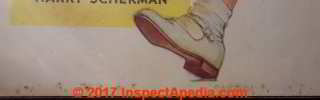
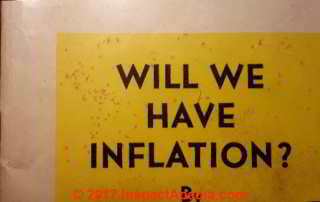
I have attached some photos of a magazine from 1941 which has brown spots on the cover, mostly around two edges. Are these mold?
If so, can it be brushed off and then gently wiped with an alcohol solution? The magazine is stored in a clear plastic cover.
When I pulled it out there was no dampness. I hope that's enough info. - Anonymous by private email 2017/08/21
Reply:
Your photos of Frances Tipton Hunter's cover illustration for The Saturday Evening Post issue of April 12, 1941 have vari-colored deposits that look like mold, not "foxing". It will be difficult to completely remove all of the mold stains unless the magazine were so valuable as to merit paying a paper conservator to do that work.
Starting at BOOK MOLD, CLEANING we list a series of suggested steps that can remove mold, though probably not entirely, from the old magazine in your photos.
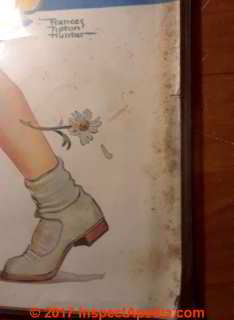
If you remove the surface mold, even if just by gentle wiping with a tissue or paper towels, and if you follow that by keeping the magazine dry and in a cool dry location, I would not expect the mold problem to get much worse.
There could be, however, some bleeding of chemicals that are already in the paper, especially if it is exposed to high humidity.
Moldy magazine page cleanup tips:
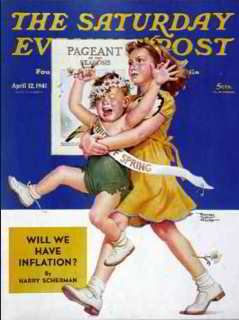
We note that this issue of The Saturday Evening Post sold for five cents when it was published in 1941. I'd wager that even sporting mold, your copy of that issue cost a bit more than that.
Here we show a cleaned-up image of the cover of the same issue of your magazine.
Watch out: What I describe below is suitable for a non-critical clean-up job of an old magazine or photo that you want to preserve. If you have a document, book, photographs of great value or of significant historical importance, take it to an expert paper conservator for treatment or at least for advice.
Based on some tests I did during a government cleanup of moldy paper goods at a historic site, I emphasize the importance of not back-contaminating or cross-contaminating surfaces even during a simple wipe-off the mold procedure.
- Personal protection: if dealing with more than a trivial amount of mold, an expert would wear a HEPA respirator or an N95 mask (less effective), nitrile gloves, etc.
Watch out : at the very least, do not get moldy crud on your fingers and then wipe the moldy fingers in your eye. You can get a nasty fungal infection of the eye.
- Diagnose it: first, are we looking at mold, dirt, or foxing? It matters because the choice of cleanup methods will vary depending on both the material to be cleaned (cloth, paper, type of paper) and on what contaminants are present (mold, foxing, grease, other stains).
Here we proceed with the assumption that it looks and smells like mold - we're not looking at foxing on paper.
See FOXING STAINS on BOOKS & PAPERS for more about that distinction.
- Dry it: First be sure that the magazine is completely dry.
- Do no harm: Second, try these methods (below) initially on an unobtrusive area of the magazine to determine that you're not making matters worse and also to confirm that the paper is not so fragile that you cannot handle it without it falling apart.
My old Civil War era newspapers are quite tough, that's because they were printed on rag paper. The Saturday Evening Post paper will have been produced much later and it is more fragile.
- Do not cross-contaminate: Use clean cotton balls or if the paper is more-fragile, use a soft brush to loosen what you can (brush to edges) or use soft tissues.
After wiping an area that's moldy, before moving on to another section start with a new clean tissue or cotton ball. Do not re-use the same wipe across multiple pages.
What we're avoiding is smearing a thin coating of moldy dust and debris into other areas of the paper surface you're cleaning. That think coat of moldy spores, even dried out mold, not only spreads dirt and crud, it also inoculates those areas to invite worse mold re-growth should the magazine spend time in humid conditions.
Watch out: do not try using facial tissues nor bathroom tissue (toilet paper) if the product is scented or coated with a lotion - that may leave harmful deposits on your magazine.
- Wipe towards edges: Fold the tissue or paper into a 4-6" square, wipe gently from the center towards the edge of the paper.
- Remove stubborn stains from magazine paper: Paper conservators might recommend using clean water along with a few drops of dish detergent to dampen a soft cloth to dab at stained areas to see if you can remove them.
The conservator might then follow more dabbing with liquid designed to bleach out stained areas: a 1:1 or 2:1 mixture of clean water with lemon juice, hydrogen peroxide, or a dilute bleach solution. Alcohol sometimes can help remove oily stains.
Watch out: All of these treatments also involve risks including the risk of bleeding a stain out into more of the paper, or over-bleaching and damaging the paper by oxidizing it. When I've tried them I use a cotton swab and do some test dabbing in a safe area first.
Whenever I've used a bleaching agent I take care to follow up with removing the bleach with repeated dabs of clean water so as not to leave an oxidizer on the paper, followed by another step to blot the paper as dry as I can get it, followed by keeping damp pages separated until they're drye.
Watch out: I'm also nervous about even plain water since water can easily re-activate mold spores and can cause new growth if you don't dry the work out quickly enough. (Wet for 48 hours is an engraved invitation to mold formation.)
Watch out: a paper conservator would, of course, follow more expert and more-rigorous methods using a soft brush like a new clean artist's brush to wipe dried mold off of the surfaces into scrap paper that will be folded into the trash. We refer to more expert methods and sources in this article series and there is more information at REFERENCES.
...
Continue reading at FOXING STAINS on BOOKS & PAPERS or select a topic from the closely-related articles below, or see the complete ARTICLE INDEX.
Or see BOOK MOLD, CLEANING FAQs - questions & answers about the conservation of moldy books and papers posted originally at the end of this page.
Or see these
Art, Book, Document, Photogaph Foxing & Mold Articles
- AEROBIOLOGY ASSOCIATIONS
- ART CONSERVATION - Cultural Heritage and Aerobiology
- ARTWORK MOLD CONTAMINATION
- BIODETERIORATION AGENT & STAIN CATALOG
- BLACK LIGHT & UV LIGHT USES
- BOOK MOLD, CLEANING
- PREPARE TO CLEAN BOOKS / PAPERS
- HEALTH HAZARDS, MOLDY BOOKS
- DUST, TYPICAL LIBRARY SHELF CONTENTS
- BOOK-MOLD CLEANUP for DO-IT-YOURSELFers
- MAGAZINE MOLD CLEANUP for DO-IT-YOURSELFers
- MILDEW on BOOKS? - no, it's NOT mildew.
- BOOK CONSERVATION RESOURCES
- FOXING STAINS on BOOKS & PAPERS
- HOARDING HAZARDS
- MILDEW ERRORS, IT's MOLD
- MILDEW PHOTOGRAPHS BUILDINGS ?
- MILDEW REMOVAL & PREVENTION
- MILDEW on BOOKS?
- MILDEW ERRORS, IT's MOLD
- MILDEW in or on PAINT
- MILDEW PHOTOGRAPHS
- PAPAYA WHITE GROWTH vs DISEASE
- MOISTURE CONTROL in BUILDINGS
- MOLD on PHOTOGRAPHS, CLEAN-UP
Other DIY mold cleanup references
- DO-IT-YOURSELF MOLD CLEANUP WARNINGS
- MOLD CLEANUP GUIDE- HOW TO GET RID OF MOLD
- MOLD CLEANUP - MISTAKES to AVOID
Suggested citation for this web page
BOOK MOLD, CLEANING at InspectApedia.com - online encyclopedia of building & environmental inspection, testing, diagnosis, repair, & problem prevention advice.
Or see this
INDEX to RELATED ARTICLES: ARTICLE INDEX to MOLD CONTAMINATION & REMEDIATION
Or use the SEARCH BOX found below to Ask a Question or Search InspectApedia
...
Ask a Question or Search InspectApedia
Try the search box just below, or if you prefer, post a question or comment in the Comments box below and we will respond promptly.
Search the InspectApedia website
Note: appearance of your Comment below may be delayed: if your comment contains an image, web link, or text that looks to the software as if it might be a web link, your posting will appear after it has been approved by a moderator. Apologies for the delay.
Technical Reviewers & References
Click to Show or Hide Citations & References
Publisher InspectApedia.com - Daniel Friedman
how to clean mold off of books
Source: https://inspectapedia.com/mold/Moldy_Book_Cleaning.php
Posted by: pricedres1987.blogspot.com
0 Response to "how to clean mold off of books"
Post a Comment